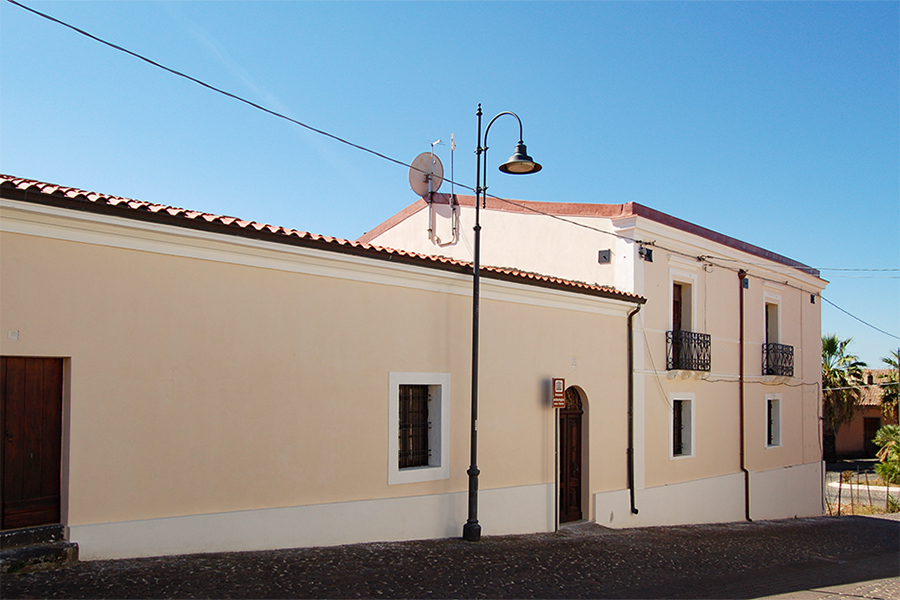
The town of Solarussa is located in the lower Tirso valley, one of the most fertile areas of the island, cultivated with vernaccia vineyards, olive groves, artichokes, tomatoes, watermelons and melons. The Latin place name, solum russus, comes from the color of the local soil. Until the mid-20th century in the localities of Bangius and Cu ‘e Forru, unfired earth bricks and tiles were produced, with which the rural Campidanese houses in the historic center were built. Casa Sanna is a splendid example with wrought-iron balconies and a large portal. It hosts cultural events and stands in the upper part of the town, next to the church of Madonna delle Grazie. The front of the graceful sanctuary features a loggia with three orders of arches and two similar bell towers. The charming parish church of St. Peter the Apostle, consecrated in 1835, houses two 18th-century paintings by painter Pietro Angeletti. Next door is the Church of the Souls, built in 1749 with precious decorations: polychrome marble altar and wooden pulpit. On a small hill on the outskirts you will find the church of St. Gregory the Great, built between the 12th and 13th centuries in ‘minor’ Romanesque style. Nearby you will observe the ruins of a well, putz’e Angius, and possibly a bathhouse, both from Roman times. At Solarussa, the Romans established a stopping station along the via maxima from Tharros to Forum Traiani. Coins, remains of domus and pottery at Cuccuru Madau also testify to their presence. Prominent among the numerous Nuragic-age settlements is the Pidighi complex, consisting of the very similar Pidighi and Muru Accas nuraghi, with respective settlements and nearby water supply sources. Both consist of a main tower and a body including an open courtyard and secondary tower. In the Mitza Pidighi spring, which was already frequented in pre-Nuragic times, as evidenced by obsidian and ceramic finds from the 4th millennium B.C., water still gushes from a small cell, around which an enclosure was built in 1000 B.C., with perhaps an altar inside.